
Kuwait-Iraq maritime dispute flares again after Iraq submits new sea coordinates to UN
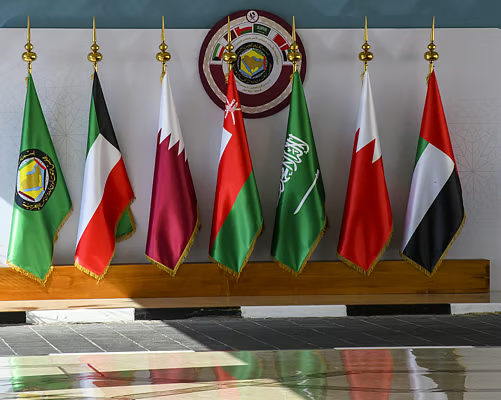
A long-running maritime border dispute between Kuwait and Iraq has resurfaced after Iraq submitted updated maps and coordinates to the United Nations. Kuwait says the new coordinates include encroachments on its sovereignty over maritime areas and fixed water elevations. Several Gulf countries, including the UAE, Qatar, Oman, Saudi Arabia, and Bahrain, have publicly backed Kuwait.
What triggered the latest row
Iraq submitted maps to the UN Secretary-General on January 19 and February 9. The documents list coordinates for Iraqi territorial sea baselines and maritime zones. Iraq said the submission was in line with the United Nations Convention on the Law of the Sea (UNCLOS) of 1982.
Kuwait argues that the new coordinates go beyond what was previously discussed. It says they include areas that were never part of any dispute.
Why Khor Abdullah matters
At the centre of the tension is Khor Abdullah, a narrow waterway in the Arabian Gulf. It lies between Kuwait’s islands of Bubiyan and Warbah and Iraq’s Al Faw Peninsula.
The issue has repeatedly strained ties, even after relations improved following political changes in Iraq in 2003. The dispute also carries the weight of history, dating back to the aftermath of Iraq’s 1990 invasion of Kuwait.
A disagreement over where the line should be drawn
Kuwait points to UN Security Council Resolution 833 from 1991. Kuwait says the resolution established both land and maritime boundaries.
Iraq argues the picture is more complicated. It says earlier coordinates did not fully address deeper offshore maritime limits.
There is also a technical disagreement over how to divide the waterway. Iraq objects to the “median line” approach in Khor Abdullah due to heavy silt accumulation. A median line is a boundary drawn at equal distance from the two shores. Iraq prefers a divide based on the deepest navigable channel, often used to keep shipping lanes workable. Kuwait does not follow that system, and the gap has fuelled the dispute.
Iraq says it is updating data under international law
Iraq’s Foreign Ministry issued a statement on Sunday, February 22. It said the map reflects the determination of straight baselines and baselines drawn along the low-water line. These are reference lines used to measure the breadth of the territorial sea.
Iraq also said the latest submission replaces previous maps sent in December 2021 and April 2011. It added that the coordinates cover the territorial sea, the contiguous zone, the exclusive economic zone, and the continental shelf.
Iraq said the data uses the World Geodetic System 1984, known as WGS-84. WGS-84 is a global standard used to describe precise geographic coordinates.
Kuwait filed an official protest note
Kuwait responded by handing an official protest note to Iraq’s Chargé d’Affaires in Kuwait on Saturday, February 21. Kuwait said the map included claims over maritime zones and fixed water elevations such as Fashat al-Qaid and Fashat al-Ayj.
Kuwait’s Foreign Ministry urged Iraq to act “seriously and responsibly” in line with international law. It also called for respect for existing understandings, agreements, and memoranda between the two countries.
Gulf countries line up behind Kuwait
Support for Kuwait quickly spread across the Gulf.
Bahrain said it had “deep concern” and described the move as an infringement on Kuwait’s sovereignty over maritime areas and fixed elevations. The UAE also expressed full solidarity with Kuwait and urged disputes to be resolved through constructive dialogue.
Oman backed Kuwait while stressing good neighbourliness and compliance with international law and UNCLOS. Saudi Arabia said it was following the matter with “high interest and concern” and rejected Iraqi claims to areas adjacent to the Saudi-Kuwaiti divided zone. Qatar reaffirmed support for Kuwait’s sovereignty over its maritime zones and fixed elevations.
The dispute is now firmly on the international stage. With Kuwait formally protesting and regional allies speaking out, pressure is rising for Baghdad and Kuwait City to return to negotiations and avoid further escalation in a sensitive waterway.