
DEWA unveils AI virtual engineer going live in June 2026
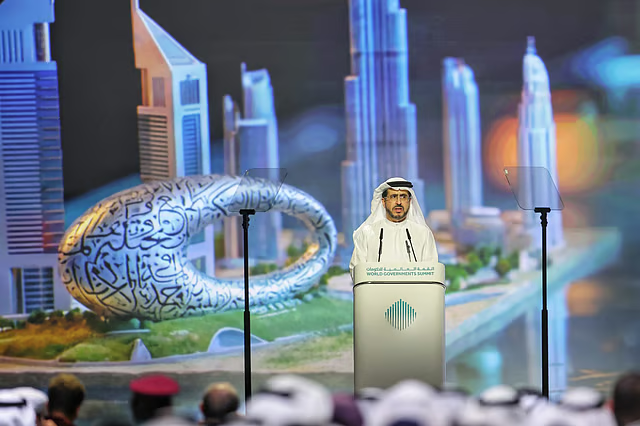
Dubai Electricity and Water Authority (DEWA) will deploy what it calls the world’s first AI-powered “Virtual Engineer” in June 2026. The system will learn from live operations and act like an experienced expert. It will issue predictive failure alerts, run root-cause analysis, calculate efficiency autonomously, recommend plant optimisation, and simulate scenarios in real time. Managing Director and CEO Saeed Mohammed Al Tayer announced the move in a speech titled “AI-Driven Energy Transformation” on the final day of the World Governments Summit.
What the “virtual engineer” will do, in practice
The tool will monitor power assets 24/7, spot anomalies early, and keep output within optimal bands during peak summer demand. DEWA says this will raise reliability and efficiency across generation, transmission, and distribution. In plain terms, it is a software expert that never sleeps. It learns from data, tests options in a safe simulation, and then suggests—or executes—actions to keep electricity stable. Local reports confirm a go-live window of June 2026.
Why this is happening now
Utilities worldwide are adding AI to control rooms to cut outages and costs. DEWA’s plan aligns with that shift and with Dubai’s digital strategy. Al Tayer stressed that AI can expand industry while reducing environmental impact and strengthening resilience. His remarks position Dubai as an early mover at the policy level, using a summit stage to lock timelines and signal readiness.
A track record that supports the claim
DEWA has already put AI into production. In 2025, it and Siemens Energy advanced a world-first AI Plant Intelligent Controller at the Jebel Ali site, using a digital twin—an exact virtual replica of a physical system used for testing and optimisation. Internal results showed measurable fuel and efficiency gains. Earlier announcements traced the controller’s roots to DEWA’s generation division.
DEWA AI virtual engineer: how it fits the wider stack
Through its digital arm, Moro Hub, DEWA operates green data centres powered by the Mohammed bin Rashid Al Maktoum Solar Park. Guinness World Records lists the complex as the world’s largest solar-powered data centre, supporting high-compute AI workloads with renewable energy. This backbone lets DEWA train, deploy, and update models at scale while keeping data local.
Customer-facing AI shows adoption at scale
DEWA’s AI assistant “Rammas,” launched in 2017, has handled more than 12.7 million customer inquiries across channels. That volume shows sustained user trust and gives DEWA a mature pipeline for AI updates. The virtual engineer extends that logic from front-office service to core operations.
What changes for residents and businesses
Short term, users should see steadier voltage, faster incident response, and better peak-hour performance. Medium term, efficiency gains can lower system costs and emissions, freeing investment for grid upgrades and clean capacity at the solar park. The move also signals to industry that Dubai’s grid is ready for data-center growth and electrification of mobility and cooling—two sectors that need tight reliability.
The bottom line
With a firm June 2026 timeline, DEWA shifts AI from pilots to round-the-clock plant intelligence. The utility couples summit-level policy with operational proof points at the Jebel Ali Power and Desalination Complex and in customer services. The “virtual engineer” turns experience into software and makes reliability a learning system. If execution matches the plan, Dubai strengthens its lead in data-driven, low-carbon power